
Ruaha National Park
The game viewing starts the moment the plane touches down. A giraffe races beside the airstrip, all legs and neck, yet oddly elegant in its awkwardness. A line of zebras parades across the runway in the giraffe’s wake.
In the distance, beneath a bulbous baobab tree, a few representatives of Ruaha’s 10,000 elephants – the largest population of any East African national park, form a protective huddle around their young.
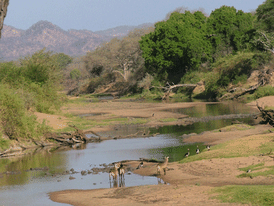
Second only to Katavi in its aura of untrammelled wilderness, but far more accessible, Ruaha protects a vast tract of the rugged, semi-arid bush country that characterises central Tanzania. Its lifeblood is the Great Ruaha River, which courses along the eastern boundary in a flooded torrent during the height of the rains, but dwindling thereafter to a scattering of precious pools surrounded by a blinding sweep of sand and rock.
A fine network of game-viewing roads follows the Great Ruaha and its seasonal tributaries, where , during the dry season, impala, waterbuck and other antelopes risk their life for a sip of life-sustaining water. And the risk is considerable: not only from the prides of 20-plus lion that lord over the savannah, but also from the cheetahs that stalk the open grassland and the leopards that lurk in tangled riverine thickets. This impressive array of large predators is boosted by both striped and spotted hyena, as well as several conspicuous packs of the highly endangered African wild dog.
